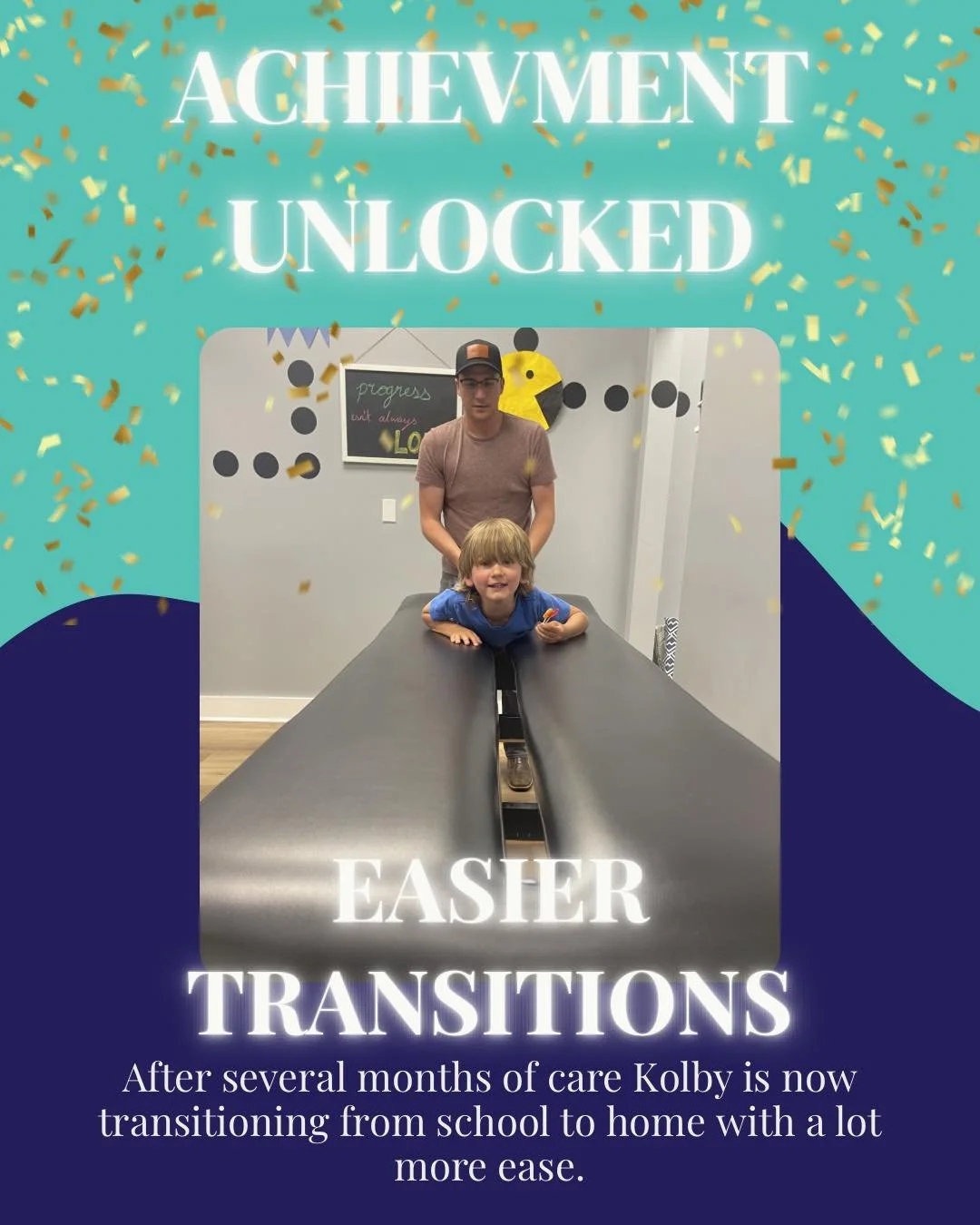
It Isn't Defiance: Understanding Why Transitions Feel So Hard
/What if it’s not defiance… but an overwhelmed nervous system?
If you’ve ever tried to move your child from one activity to another, leaving the house, turning off a show, switching routines… you may have felt it:
The resistance.
The overwhelm.
The emotional wave that seems to come out of nowhere.
And in those moments, it’s easy to wonder…
“Why is this so hard?”
“Why won’t they just listen?”
But what if we’ve been looking at it through the wrong lens?
What if it’s not defiance at all?
A Different Way to See It
Imagine you’re driving down the highway at full speed.
Music is playing.
Your mind is focused.
Your body is in motion.
And suddenly, without warning, someone slams on the brakes.
Your whole system reacts instantly.
Your body jolts. Your heart races. Your focus scrambles.
That’s not a behavior problem.
That’s your nervous system trying to adapt as quickly as possible.
Now imagine living in a body where those “panic moments” happen more intensely, more frequently, and with less warning.
That’s what transitions can feel like.
Transitions Are Neurological, Not Behavioral
For many kids, especially those navigating sensory and environmental stress differently, transitions aren’t just “switching activities.”
They’re a full-body experience.
It’s the brain and body working to:
shift focus
process new input
let go of one state and enter another
And when that system is already carrying stress, that shift can feel overwhelming.
So what we often label as:
“not listening”
“being difficult”
“throwing a fit”
…is often a nervous system saying,
“This is too much, too fast.”
The Iceberg Beneath the Moment
What we see on the surface is the reaction.
But underneath?
There’s processing.
There’s adaptation.
There’s effort.
Think of it like an iceberg
the visible moment is just a small piece of a much bigger internal experience.
And when we begin to see it that way, something shifts:
From frustration → to understanding
From control → to connection
Supporting the Transition (Don’t Force It)
When we recognize that transitions are neurological, our approach begins to change.
Instead of pushing harder, we can:
create more predictability
give gentle cues before transitions happen
allow space for the body to catch up
stay calm and grounded ourselves
Because regulation doesn’t come from pressure—it comes from safety.
Why This Matters
At Crossroads, we talk a lot about adaptability.
Because life is full of transitions.
Big ones, small ones, expected and unexpected.
And the goal isn’t to eliminate those moments… it’s to help the body handle them better over time. A phrase you will commonly hear in our office is, “more good days, less bad days.” We are never chasing perfection but progress.
When the nervous system is more adaptable, transitions don’t feel as overwhelming.
They become smoother, more manageable, more integrated.
Not perfect.
But more connected.
A Final Thought
The next time a transition feels hard, pause before labeling the behavior.
And consider this:
It might not be defiance.
It might be a nervous system doing its best to adapt.
And that shift in perspective?
That can be where real connection begins.